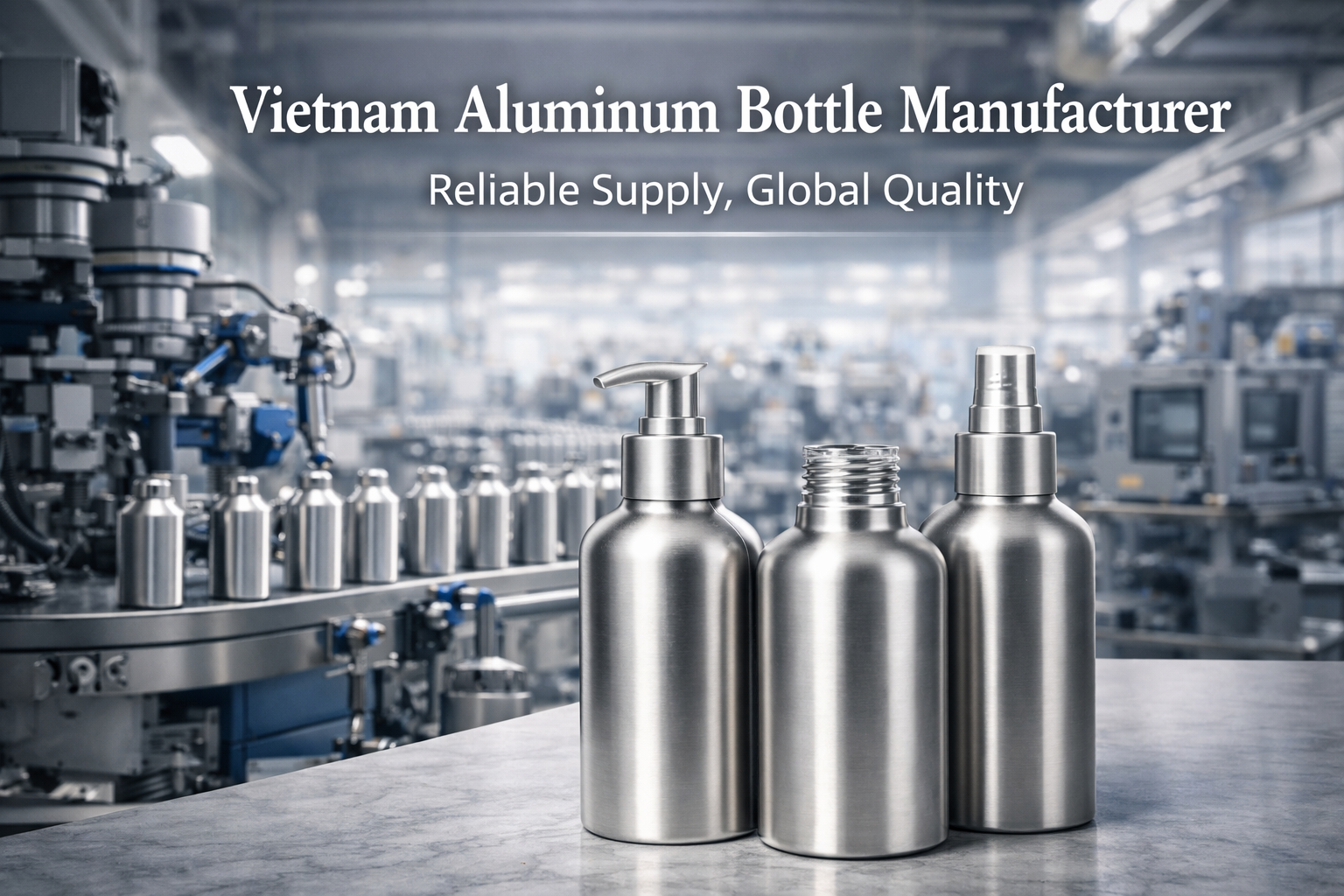
Vietnam factory capability & export readiness: Factory capacity & lead time
When sourcing an international supplier, distributors do not evaluate only the finished product. They also assess the factory behind it. A manufacturer with clear production capability, a strong quality control system, and consistent delivery performance can significantly reduce supply chain risk. That is why factory capability, certifications, and export readiness are becoming core criteria when selecting partners.
For businesses looking for an aluminum bottle factory in Vietnam, evaluating real factory capability matters far more than reviewing general introductions. The right partner needs more than production capacity. They must demonstrate stable operations, readiness for international standards, and effective coordination throughout order handling. As competition increases and delivery requirements tighten, factory capability and order lead time should always be assessed together.
The role of factory capability in supplier selection
Production capability directly impacts order stability
When working with a factory, distributors rarely focus on only the first shipment. What they need is consistency across repeated orders, especially once a product is placed into distribution and supply must remain stable. In that case, factory production capability becomes a decisive indicator.
If a factory cannot maintain steady capacity, lacks operational stability, or depends heavily on isolated production stages, the risk of delays or inconsistent quality increases. In contrast, a factory with proven capability typically shows stronger production organization, tighter process control, and better flexibility when demand changes.
For international customers, especially distributors, this stability is critical. If one link in the supply chain is uncertain, the entire plan for sales, inventory, and trade execution can be affected. Factory capability should not be treated as background information. It should be the basis for evaluating long term partnership sustainability.
Delivery lead time is a key metric for international distributors
In international trade, delivery lead time is not simply the time needed to complete production. It directly affects inbound planning, distribution schedules, inventory turnover, and buyer side operational efficiency. A factory may deliver a strong product, but if it cannot maintain reasonable and consistent delivery timing, trust in the partnership drops.
Stable lead time allows distributors to plan more proactively. They can build clear purchase schedules, organize sales activity, and reduce operational pressure caused by late deliveries. When lead time is inconsistent, supply chain risk increases, from higher operating costs to the risk of market disruption.
That is why lead time should not be treated as a single number. Buyers should evaluate whether the factory can maintain lead time across multiple orders, provide accurate progress updates, and handle changes when production plans shift.
Aluminum bottle factories in Vietnam and the current export context
Vietnam is gaining attention in packaging supply chains
In recent years, Vietnam has been mentioned more often as a manufacturing destination in regional supply chains. Beyond consumer goods and light industry, packaging is also receiving increasing attention from international customers, especially companies seeking to diversify sourcing and reduce reliance on a single market.
For aluminum bottles, Vietnam has an advantage in developing production with flexibility and working effectively with different customer needs. As global markets place more emphasis on supply stability, factories in Vietnam have an opportunity to become strong options for buyers looking for long term partners.
This attention also raises expectations for factories. Beyond producing well, factories must show export readiness, transparent documentation, and professional coordination with overseas customers. This is what turns location advantage into real competitive advantage.
Advantages of Vietnamese factories for export oriented partnerships
One factor international customers often value in Vietnam is the ability to balance production, quality, and operational flexibility. For distributors who need partners that respond quickly, coordinate clearly, and support specific requirements, flexibility has strong practical value.
Vietnamese factories also gain an advantage when they build clear workflows and stable control systems. For international customers, professionalism in communication, transparency in lead time, and readiness of documentation often matter as much as the product itself. When a factory meets these expectations, its export readiness is viewed more positively.
In that context, “an aluminum bottle factory in Vietnam” is no longer only about the manufacturing location. It is also about how the factory organizes capability, maintains quality, and demonstrates readiness to work with international markets.
What to evaluate when assessing factory capability
Production scale and ability to fulfill orders
Production scale is one of the first factors buyers review. However, scale is not only facility size or equipment count. The key is whether scale translates into real supply performance, meaning the factory can process orders consistently, maintain stable output, and handle demand increases when needed.
A factory with the right scale builds a stronger foundation for lead time stability. This matters for distributors because they rarely place one order and stop. They need repeatable supply, scalable volume, and consistent quality as quantities increase.
When evaluating scale, buyers should focus on real fulfillment ability rather than marketing numbers. Questions about capacity at each production stage, flexibility when handling multiple orders, and consistency across batches will provide a more accurate picture.
Operational stability and quality control discipline
A capable factory is not only one that can produce. It is one that can produce consistently. Operational stability shows up in internal workflows, raw material control, cross department coordination, and how the factory responds when plans change.
If operations are unstable, quality and lead time become difficult to maintain. In contrast, a factory with a clear control system gives buyers greater confidence because each step can be tracked and evaluated. This becomes even more important as international expectations for quality continue to rise.
Quality control should not appear only as a general statement in a capability profile. It should be supported by defined procedures, documentation methods, deviation tracking, and consistency measures. When buyers see this clearly, trust increases.
Ability to support multiple product lines and varied requirements
In B2B, customer needs are rarely identical. Some customers require standard items, while others need customization, specific documentation, or special coordination during production. A strong factory should demonstrate not only the ability to produce one item, but also the ability to adapt to different operational requirements.
This is especially important for distributors serving multiple markets and customer groups with different brand and compliance expectations. A factory that can coordinate well in diverse scenarios delivers significantly higher value than one offering only a fixed solution.
The ability to support varied requirements also signals strong organization. It reflects planning capability, internal coordination, and systematic management rather than case by case execution.
Certifications and quality systems in the factory
Certifications build early trust in international cooperation
For international customers, certifications are not simply supporting documents. They are often the first proof point of seriousness and professionalism. When evaluating remotely without a direct audit, certifications help buyers understand the factory’s management standards and operational discipline.
Certifications do not replace real capability. However, if a factory cannot provide clear documentation or demonstrate a quality management foundation, trust becomes harder to establish. In contrast, a factory with relevant certifications, clear documentation, and transparent presentation typically creates a stronger first impression during evaluation.
That is why certifications should be treated as a key part of the factory profile, especially for factories targeting international customers and positioning as reliable export partners.
Quality control must be clearly shown in the capability profile
An effective capability profile should not only list strengths in general terms. It should clearly explain how quality is controlled, how production is tracked, and how output consistency is maintained. This is what moves buyers from interest to trust.
When quality control is described clearly, customers can better understand how the factory operates. They want to see where inspections happen, what criteria are used, how results are recorded, and how deviations are handled. This information does not need to be long, but it must be specific enough to show a real system.
For distributors, this is critical because they consider long term risk. Strong quality in the first shipment is not enough. They need confidence that quality can be maintained over time across multiple orders and operating conditions.
Transparency in documents and evaluation processes
Transparency helps factory evaluation move faster and more effectively. When documents are well prepared, information is consistent, and processes are explained clearly, buyers can decide more smoothly. When information is vague, outdated, or inconsistent, doubt increases.
Transparency also reflects the factory’s working style. A transparent partner feels more reliable because they allow customers to see how they operate. This is essential when the relationship is new and early decisions rely heavily on documents, communication, and responsiveness.
In many cases, customers do not require complex systems. They want clear information, focused responses, and a cooperation process that is easy to follow. Factories that deliver this often have a clear advantage in closing early partnerships.
Production progress and delivery timing in export operations
Why lead time strongly impacts distribution planning
Lead time is one of the most important factors for distributors because it directly affects purchasing and downstream distribution planning. If delivery timing is unclear or changes repeatedly, buyers struggle to plan inventory, allocate resources, and maintain stable business rhythm.
In international operations, even small delays can create major consequences. Late arrivals can disrupt sales plans, increase storage costs, or cause missed distribution windows. Lead time is not a minor detail. It is an operational factor that directly affects commercial performance.
The better a factory can forecast and maintain lead time, the higher its credibility. That is why international customers evaluate delivery performance not only by speed, but by stability and commitment.
What determines delivery performance
Delivery timing depends on multiple connected factors, including production capacity, raw material planning, quality control flow, and internal coordination. If any part of this chain is unstable, the entire schedule can be affected.
Standardized processes also play a major role. Factories with clear workflows typically manage tasks more smoothly, reduce errors, and provide better progress updates. This is a key difference between factories that operate case by case and factories that can run at export scale.
When evaluating delivery performance, buyers should not only ask for a quoted lead time. They should also assess planning methods, progress update discipline, and how the factory handles issues when changes occur. These reveal real execution capability.
How businesses reduce delay risk in the supply chain
To reduce delay risk, the most important step is choosing partners who coordinate clearly from the start. This includes order processing timelines, tracking milestones, progress updates, and response methods when changes happen. When both sides align expectations early, the risk of misunderstanding and disruption drops significantly.
From the factory side, building a clear lead time management process is necessary to support long term international cooperation. From the buyer side, lead time evaluation should be paired with evaluation of organization and communication. A factory may not always offer the shortest timeline, but if it delivers stability and transparency, it can be the more reliable long term partner.
FAQ
Should buyers prioritize production capability or delivery lead time
Both matter and should be evaluated together. Production capability creates the base for order fulfillment, while lead time reflects stability and execution in real operations.
Why are certifications important in international cooperation
Certifications help establish early trust and show that the factory operates with clearer management foundations. They are an important part of evaluating readiness for long term cooperation.
Does lead time significantly affect distributors
Yes. Lead time directly impacts purchasing, inventory, and distribution. If unstable, it can disrupt the buyer’s entire supply chain.
What should a Vietnam aluminum bottle factory prepare for international customers
Factories should be prepared in production capability, export documentation, certification information, quality control processes, and clear coordination throughout order execution.
Should buyers evaluate a factory through documents or real communication
Both. Documents provide an overview, while real communication shows transparency, responsiveness, and working style.
What defines a suitable long term partner
A suitable partner has proven capability, consistent quality, reliable lead time, transparent documentation, and professional cooperation. These factors support long term partnerships more effectively than price alone.
Conclusion
As supply chains are evaluated more strictly, factory selection cannot be based only on product or price. For international distributors, the priority is finding partners with proven production capability, reliable quality control systems, relevant certifications, and the ability to maintain stable lead times. For businesses sourcing aluminum bottle factories in Vietnam, evaluating real capability and export readiness reduces cooperation risk and creates a stronger foundation for long term distribution planning. When a factory proves capability, maintains transparency in documentation, and collaborates professionally, it becomes the basis for a sustainable partnership in international markets.
—-------
Contact GREEN PACK for sample consultation and a fast quotation.
Viber • Zalo • WhatsApp • WeChat: (+84)903 83 33 44 | (+84)901 379 138